
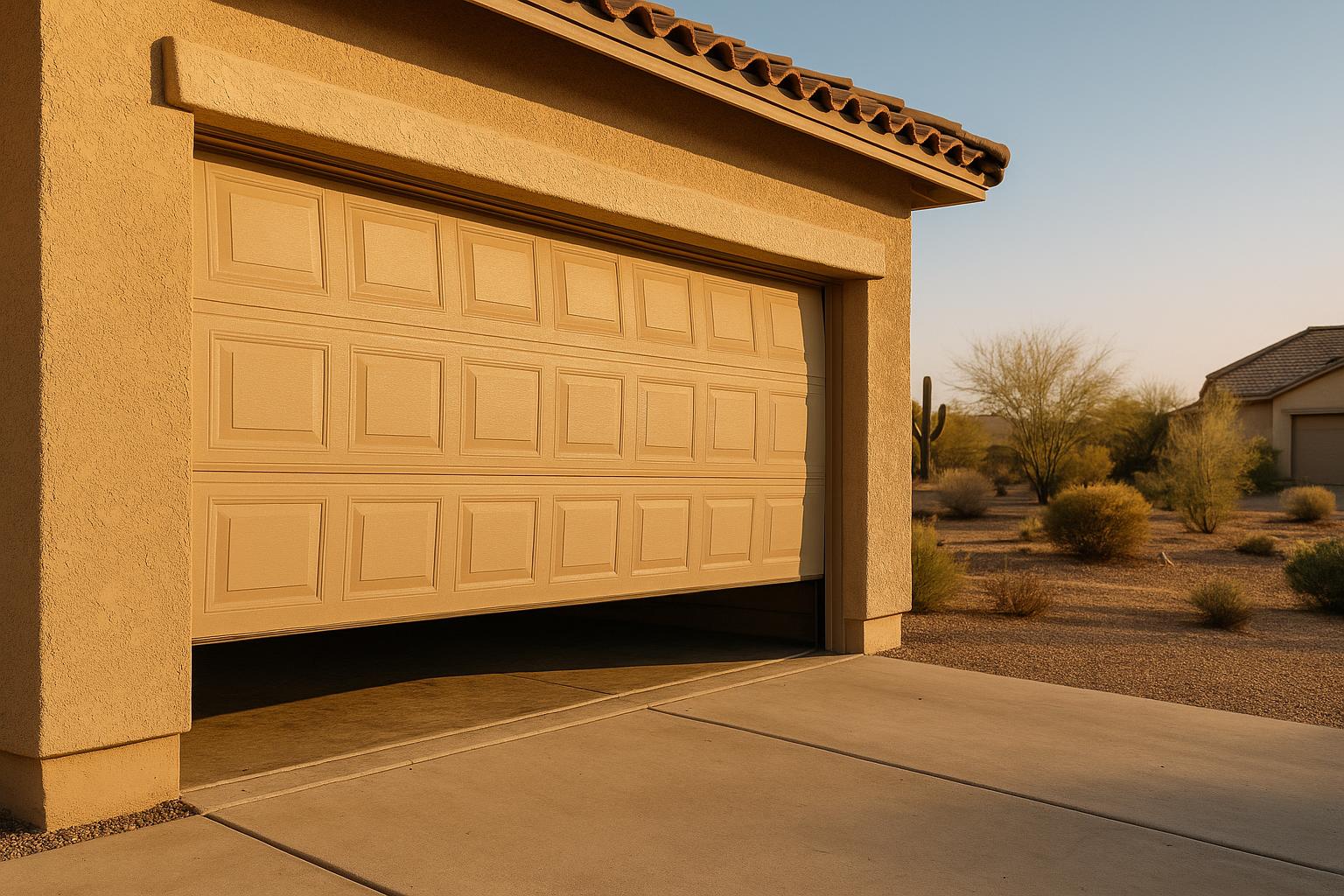
That Frustrating Moment When Your Garage Door Won't Stay Closed
You press the button on your remote. The garage door starts coming down. Then, about halfway — or maybe just inches from the ground — it stops, reverses, and goes right back up. You try again. Same thing. Maybe you try holding the wall button. Still nothing.
This is one of the most common garage door complaints we hear from homeowners in Apple Valley, and it's more than just an annoyance. A garage door that won't fully close is a security risk, an energy waste, and an open invitation for dust, critters, and the extreme High Desert heat to invade your garage.
The good news? In most cases, the cause is straightforward and fixable. Let's walk through the most likely reasons your garage door reverses before hitting the floor — and what you can do about each one.
1. Misaligned Safety Sensors
This is the number one reason garage doors reverse, and it's where every troubleshooting session should start.
Since 1993, all garage door openers sold in the United States have been required to include photoelectric safety sensors. These are the two small devices mounted near the bottom of your garage door tracks, about six inches off the ground. One sends an invisible infrared beam to the other. If anything breaks that beam — a child, a pet, a trash can — the door reverses to prevent injury or damage.
The problem is that these sensors can become misaligned over time. A bump from a bicycle, vibration from daily use, or even the settling of your home's foundation can knock one sensor slightly out of position. When the sensors can't "see" each other, the opener interprets that as an obstruction and reverses the door.
What to check:
- Look at the LED lights on both sensors. Typically, one should glow steady green and the other steady amber or green. If either light is blinking, the sensors are misaligned or have a wiring issue.
- Make sure nothing is blocking the beam path — cobwebs, dirt, or debris on the sensor lenses are common culprits here in Apple Valley, especially after windstorms.
- Gently adjust the sensors until both lights are solid, then test the door again.
2. The Close-Limit Switch Needs Adjustment
Your garage door opener has built-in limit settings that tell it exactly how far the door should travel when opening and closing. Think of it as the opener's internal map of where the floor is.
If the close-limit is set incorrectly — meaning the opener thinks the door should stop before it actually reaches the ground — the opener may interpret the continued travel as resistance and trigger a reversal. This often happens after a new opener installation, a spring replacement, or sometimes with no obvious trigger at all.
What to check:
- Consult your opener's manual for instructions on adjusting the down-limit or close-limit setting. On most models, it involves turning a small screw or pressing buttons on the motor unit.
- Make small adjustments and test after each one. Over-adjusting can cause the door to press too hard against the floor, which creates a different set of problems.
3. Worn or Damaged Rollers and Tracks
Your garage door rides along metal tracks on rollers. When those rollers wear out, crack, or become clogged with grit and debris, the door doesn't glide smoothly. The opener senses that extra friction as an obstruction and — you guessed it — reverses.
In the High Desert, dust and sand are constant companions. Homeowners in Apple Valley, Hesperia, and Victorville tend to see roller and track issues more frequently than people in milder climates simply because of the particulate matter that accumulates in garages.
What to check:
- Visually inspect the rollers. If they're cracked, chipped, or no longer spinning freely, they need to be replaced.
- Look at the tracks for dents, bends, or buildup of dirt. Wipe the tracks clean with a dry cloth, but avoid using WD-40 or grease on the tracks themselves — it attracts more dust.
- Nylon rollers are a great upgrade for desert environments because they're quieter and don't require lubrication.
4. Broken or Weakening Torsion Springs
Your garage door's torsion springs do the heavy lifting — literally. They counterbalance the weight of the door so the opener only has to provide a small amount of force to move it. When a spring weakens or breaks, the door becomes much heavier than the opener expects.
A modern garage door opener has a force-sensing mechanism. If it detects that the door requires more force than normal to move, it assumes something is wrong and reverses. A weakening spring can cause intermittent reversals that seem random — the door might close fine in the morning when temperatures are warmer and the spring is more pliable, then reverse in the evening when it cools down.
Important: Torsion spring repair is dangerous. These springs are under extreme tension, and attempting a DIY replacement can result in serious injury. This is one repair that should always be handled by a trained technician.
5. The Opener's Force Settings Are Too Low
In addition to limit settings, your opener also has force settings that control how much power the motor uses to open and close the door. If the closing force is set too low, the opener may not have enough power to push the door all the way down, especially if there's even minor friction in the system.
What to check:
- Try increasing the down-force setting slightly using the adjustment screw or controls on your opener unit.
- Test the door after each small adjustment. The door should close fully but should still reverse when it encounters real resistance — like your hand pushing against the bottom edge. If it doesn't reverse with manual resistance, the force is set too high, which is a safety hazard.
6. Damaged or Warped Door Panels
Over time, garage door panels can warp, crack, or become damaged from impacts. A warped panel can cause the door to bind in the tracks at a certain point during travel, triggering a reversal. This is especially common with older wooden doors or with steel doors that have taken a hit from a vehicle or sports equipment.
If you notice the door reverses at the same point every time, watch it closely from inside the garage. You may see the door flexing or catching at a specific panel.
When to Call a Professional
Some of these fixes — cleaning sensors, adjusting limit switches — are reasonable for a handy homeowner to tackle. But many garage door issues involve components under high tension or electrical systems that can be hazardous if handled incorrectly.
If you've tried the basic troubleshooting steps and your door is still reversing, or if you suspect a spring, cable, or structural issue, it's time to call in a professional. At Apple Valley Garage Door Service, we diagnose and repair reversing doors regularly for homeowners across Apple Valley, Victorville, Hesperia, and the surrounding communities. We'll identify the root cause, explain your options in plain language, and get your door working properly — usually in a single visit.
Don't Ignore a Reversing Garage Door
A garage door that won't close isn't just inconvenient. It leaves your home vulnerable to break-ins, lets conditioned air escape, and exposes your belongings to dust, heat, and pests. In a place like Apple Valley where summer temperatures regularly exceed 100°F, an open garage can significantly impact your energy bills.
Whether the fix is a simple sensor adjustment or a full spring replacement, addressing the problem quickly saves you money and keeps your family safe. If you need help, give us a call — we're local, we're honest, and we'll get it done right.